 56427f287e
<!-- .github/pull_request_template.md --> ## Description This demo uses pydantic models and dlt to pull data from the Pokémon API and structure it into a relational format. By feeding this structured data into cognee, it makes searching across multiple tables easier and more intuitive, thanks to the relational model. ## DCO Affirmation I affirm that all code in every commit of this pull request conforms to the terms of the Topoteretes Developer Certificate of Origin <!-- This is an auto-generated comment: release notes by coderabbit.ai --> ## Summary by CodeRabbit - **New Features** - Introduced a comprehensive Pokémon data processing pipeline, available as both a Python script and an interactive Jupyter Notebook. - Enabled asynchronous operations for efficient data collection and querying, including an integrated search functionality. - Improved error handling and data validation during the data fetching and processing stages for a smoother user experience. <!-- end of auto-generated comment: release notes by coderabbit.ai --> Co-authored-by: Vasilije <8619304+Vasilije1990@users.noreply.github.com> |
||
|---|---|---|
| .data | ||
| .dlt | ||
| .github | ||
| alembic | ||
| assets | ||
| bin | ||
| cognee | ||
| cognee-frontend | ||
| cognee-mcp | ||
| evals | ||
| examples | ||
| helm | ||
| licenses | ||
| notebooks | ||
| profiling | ||
| tests | ||
| tools | ||
| .dockerignore | ||
| .env.template | ||
| .gitignore | ||
| .pre-commit-config.yaml | ||
| .pylintrc | ||
| .python-version | ||
| alembic.ini | ||
| CODE_OF_CONDUCT.md | ||
| cognee-gui.py | ||
| CONTRIBUTING.md | ||
| DCO.md | ||
| docker-compose.yml | ||
| Dockerfile | ||
| Dockerfile_modal | ||
| entrypoint.sh | ||
| LICENSE | ||
| modal_deployment.py | ||
| mypy.ini | ||
| NOTICE.md | ||
| poetry.lock | ||
| pyproject.toml | ||
| README.md | ||

cognee - memory layer for AI apps and Agents
Learn more · Join Discord · Demo





AI Agent responses you can rely on.
Build dynamic Agent memory using scalable, modular ECL (Extract, Cognify, Load) pipelines.
More on use-cases.
Features
- Interconnect and retrieve your past conversations, documents, images and audio transcriptions
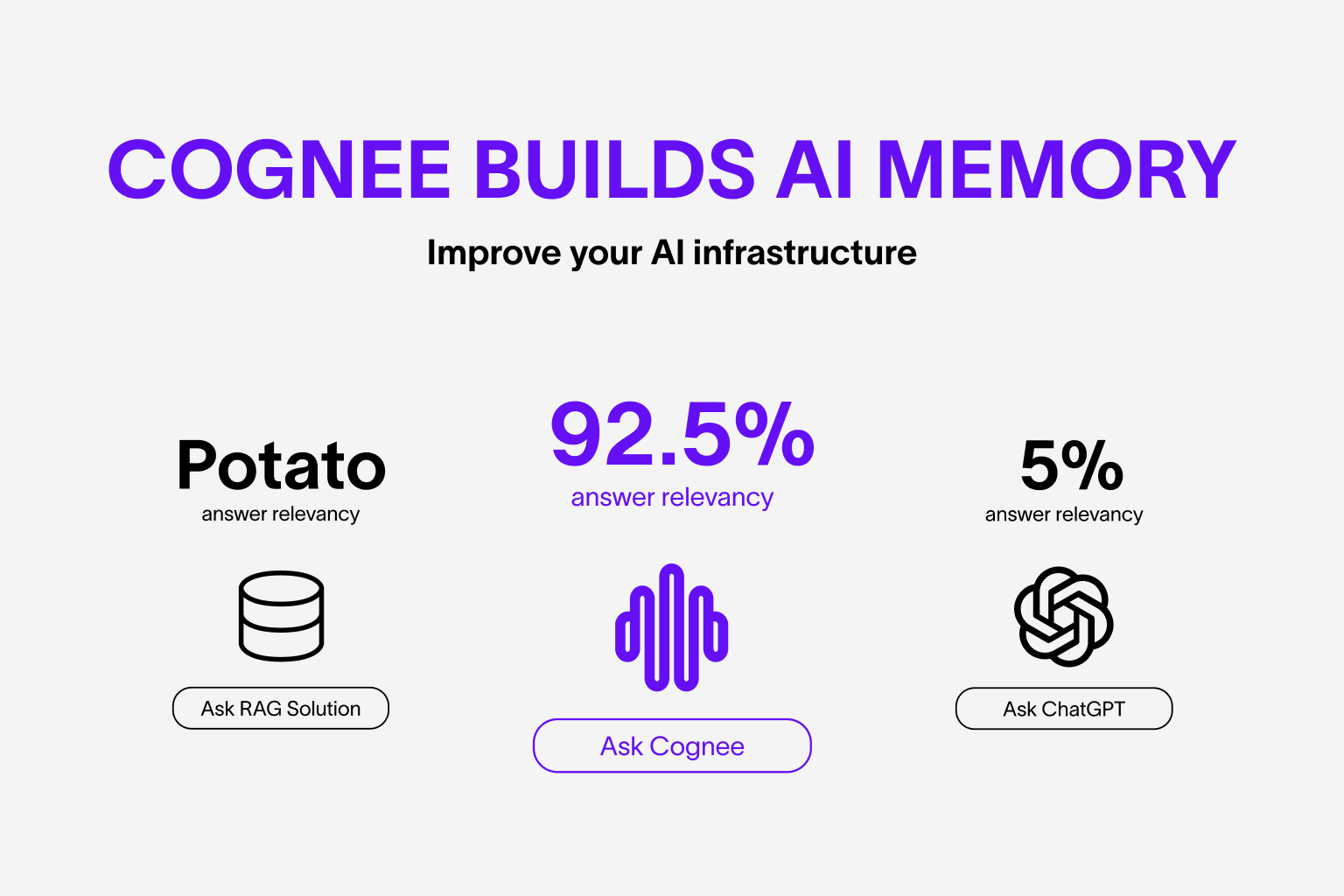
- Reduce hallucinations, developer effort, and cost.
- Load data to graph and vector databases using only Pydantic
- Manipulate your data while ingesting from 30+ data sources
Get Started
Get started quickly with a Google Colab notebook or starter repo
Contributing
Your contributions are at the core of making this a true open source project. Any contributions you make are greatly appreciated. See CONTRIBUTING.md for more information.
📦 Installation
You can install Cognee using either pip, poetry, uv or any other python package manager.
With pip
pip install cognee
💻 Basic Usage
Setup
import os
os.environ["LLM_API_KEY"] = "YOUR OPENAI_API_KEY"
You can also set the variables by creating .env file, using our template. To use different LLM providers, for more info check out our documentation
Simple example
Add LLM_API_KEY to .env using the command bellow.
echo "LLM_API_KEY=YOUR_OPENAI_API_KEY" > .env
You can see available env variables in the repository .env.template file.
This script will run the default pipeline:
import cognee
import asyncio
from cognee.modules.search.types import SearchType

async def main():
    # Create a clean slate for cognee -- reset data and system state
    await cognee.prune.prune_data()
    await cognee.prune.prune_system(metadata=True)
    # cognee knowledge graph will be created based on this text
    text = """
    Natural language processing (NLP) is an interdisciplinary
    subfield of computer science and information retrieval.
    """

    print("Adding text to cognee:")
    print(text.strip())
    # Add the text, and make it available for cognify
    await cognee.add(text)

    # Use LLMs and cognee to create knowledge graph
    await cognee.cognify()
    print("Cognify process complete.\n")


    query_text = "Tell me about NLP"
    print(f"Searching cognee for insights with query: '{query_text}'")
    # Query cognee for insights on the added text
    search_results = await cognee.search(
        query_text=query_text, query_type=SearchType.INSIGHTS
    )

    print("Search results:")
    # Display results
    for result_text in search_results:
        print(result_text)

    # Example output:
       # ({'id': UUID('bc338a39-64d6-549a-acec-da60846dd90d'), 'updated_at': datetime.datetime(2024, 11, 21, 12, 23, 1, 211808, tzinfo=datetime.timezone.utc), 'name': 'natural language processing', 'description': 'An interdisciplinary subfield of computer science and information retrieval.'}, {'relationship_name': 'is_a_subfield_of', 'source_node_id': UUID('bc338a39-64d6-549a-acec-da60846dd90d'), 'target_node_id': UUID('6218dbab-eb6a-5759-a864-b3419755ffe0'), 'updated_at': datetime.datetime(2024, 11, 21, 12, 23, 15, 473137, tzinfo=datetime.timezone.utc)}, {'id': UUID('6218dbab-eb6a-5759-a864-b3419755ffe0'), 'updated_at': datetime.datetime(2024, 11, 21, 12, 23, 1, 211808, tzinfo=datetime.timezone.utc), 'name': 'computer science', 'description': 'The study of computation and information processing.'})
       # (...)
        #
        # It represents nodes and relationships in the knowledge graph:
        # - The first element is the source node (e.g., 'natural language processing').
        # - The second element is the relationship between nodes (e.g., 'is_a_subfield_of').
        # - The third element is the target node (e.g., 'computer science').

if __name__ == '__main__':
    asyncio.run(main())
For more advanced usage, have a look at our documentation.
Understand our architecture

Demos
What is AI memory:
Code of Conduct
We are committed to making open source an enjoyable and respectful experience for our community. See CODE_OF_CONDUCT for more information.