 d30adb53f3
* feat: Add support for LlamaIndex Document type Added support for LlamaIndex Document type Feature #COG-337 * docs: Add Jupyer Notebook for cognee with llama index document type Added jupyter notebook which demonstrates cognee with LlamaIndex document type usage Docs #COG-337 * feat: Add metadata migration from LlamaIndex document type Allow usage of metadata from LlamaIndex documents Feature #COG-337 * refactor: Change llama index migration function name Change name of llama index function Refactor #COG-337 * chore: Add llama index core dependency Downgrade needed on tenacity and instructor modules to support llama index Chore #COG-337 * Feature: Add ingest_data_with_metadata task Added task that will have access to metadata if data is provided from different data ingestion tools Feature #COG-337 * docs: Add description on why specific type checking is done Explained why specific type checking is used instead of isinstance, as isinstace returns True for child classes as well Docs #COG-337 * fix: Add missing parameter to function call Added missing parameter to function call Fix #COG-337 * refactor: Move storing of data from async to sync function Moved data storing from async to sync Refactor #COG-337 * refactor: Pretend ingest_data was changes instead of having two tasks Refactor so ingest_data file was modified instead of having two ingest tasks Refactor #COG-337 * refactor: Use old name for data ingestion with metadata Merged new and old data ingestion tasks into one Refactor #COG-337 * refactor: Return ingest_data and save_data_to_storage Tasks Returned ingest_data and save_data_to_storage tasks Refactor #COG-337 * refactor: Return previous ingestion Tasks to add function Returned previous ignestion tasks to add function Refactor #COG-337 * fix: Remove dict and use string for search query Remove dictionary and use string for query in notebook and simple example Fix COG-337 * refactor: Add changes request in pull request Added the following changes that were requested in pull request: Added synchronize label, Made uniform syntax in if statement in workflow, fixed instructor dependency, added llama-index to be optional Refactor COG-337 * fix: Resolve issue with llama-index being mandatory Resolve issue with llama-index being mandatory to run cognee Fix COG-337 * fix: Add install of llama-index to notebook Removed additional references to llama-index from core cognee lib. Added llama-index-core install from notebook Fix COG-337 --------- |
||
|---|---|---|
| .data | ||
| .dlt | ||
| .github | ||
| alembic | ||
| assets | ||
| bin | ||
| cognee | ||
| cognee-frontend | ||
| docs | ||
| evals | ||
| examples | ||
| notebooks | ||
| tests | ||
| tools | ||
| .dockerignore | ||
| .env.template | ||
| .gitignore | ||
| .pylintrc | ||
| .python-version | ||
| alembic.ini | ||
| CONTRIBUTING.md | ||
| docker-compose.yml | ||
| Dockerfile | ||
| entrypoint-old.sh | ||
| entrypoint.sh | ||
| LICENSE | ||
| mkdocs.yml | ||
| mypy.ini | ||
| poetry.lock | ||
| pyproject.toml | ||
| README.md | ||
cognee



We build for developers who need a reliable, production-ready data layer for AI applications
What is cognee?
Cognee implements scalable, modular ECL (Extract, Cognify, Load) pipelines that allow you to interconnect and retrieve past conversations, documents, and audio transcriptions while reducing hallucinations, developer effort, and cost. Try it in a Google Colab notebook or have a look at our documentation
If you have questions, join our Discord community
📦 Installation
With pip
pip install cognee
With pip with PostgreSQL support
pip install 'cognee[postgres]'
With poetry
poetry add cognee
With poetry with PostgreSQL support
poetry add cognee -E postgres
💻 Basic Usage
Setup
import os

os.environ["LLM_API_KEY"] = "YOUR OPENAI_API_KEY"
or
import cognee
cognee.config.set_llm_api_key("YOUR_OPENAI_API_KEY")
You can also set the variables by creating .env file, here is our template. To use different LLM providers, for more info check out our documentation
If you are using Network, create an account on Graphistry to visualize results:
cognee.config.set_graphistry_config({
    "username": "YOUR_USERNAME",
    "password": "YOUR_PASSWORD"
})
(Optional) To run the UI, go to cognee-frontend directory and run:
npm run dev
or run everything in a docker container:
docker-compose up
Then navigate to localhost:3000
If you want to use the UI with PostgreSQL through docker-compose make sure to set the following values in the .env file:
DB_PROVIDER=postgres

DB_HOST=postgres
DB_PORT=5432

DB_NAME=cognee_db
DB_USERNAME=cognee
DB_PASSWORD=cognee
Simple example
First, copy .env.template to .env and add your OpenAI API key to the LLM_API_KEY field.
Optionally, set VECTOR_DB_PROVIDER="lancedb" in .env to simplify setup.
This script will run the default pipeline:
import cognee
import asyncio
from cognee.api.v1.search import SearchType

async def main():
    # Reset cognee data
    await cognee.prune.prune_data()
    # Reset cognee system state
    await cognee.prune.prune_system(metadata=True)

    text = """
    Natural language processing (NLP) is an interdisciplinary
    subfield of computer science and information retrieval.
    """

    # Add text to cognee
    await cognee.add(text)

    # Use LLMs and cognee to create knowledge graph
    await cognee.cognify()

    # Search cognee for insights
    search_results = await cognee.search(
        SearchType.INSIGHTS,
        "Tell me about NLP",
    )

    # Display results
    for result_text in search_results:
        print(result_text)
        # natural_language_processing is_a field
        # natural_language_processing is_subfield_of computer_science
        # natural_language_processing is_subfield_of information_retrieval

asyncio.run(main())
A version of this example is here: examples/pyton/simple_example.py
Create your own memory store
cognee framework consists of tasks that can be grouped into pipelines. Each task can be an independent part of business logic, that can be tied to other tasks to form a pipeline. These tasks persist data into your memory store enabling you to search for relevant context of past conversations, documents, or any other data you have stored.
Example: Classify your documents
Here is an example of how it looks for a default cognify pipeline:
- To prepare the data for the pipeline run, first we need to add it to our metastore and normalize it:
Start with:
text = """Natural language processing (NLP) is an interdisciplinary
       subfield of computer science and information retrieval"""

await cognee.add(text) # Add a new piece of information
- In the next step we make a task. The task can be any business logic we need, but the important part is that it should be encapsulated in one function.
Here we show an example of creating a naive LLM classifier that takes a Pydantic model and then stores the data in both the graph and vector stores after analyzing each chunk. We provided just a snippet for reference, but feel free to check out the implementation in our repo.
async def chunk_naive_llm_classifier(
    data_chunks: list[DocumentChunk],
    classification_model: Type[BaseModel]
):
    # Extract classifications asynchronously
    chunk_classifications = await asyncio.gather(
        *(extract_categories(chunk.text, classification_model) for chunk in data_chunks)
    )

    # Collect classification data points using a set to avoid duplicates
    classification_data_points = {
        uuid5(NAMESPACE_OID, cls.label.type)
        for cls in chunk_classifications
    } | {
        uuid5(NAMESPACE_OID, subclass.value)
        for cls in chunk_classifications
        for subclass in cls.label.subclass
    }

    vector_engine = get_vector_engine()
    collection_name = "classification"

    # Define the payload schema
    class Keyword(BaseModel):
        uuid: str
        text: str
        chunk_id: str
        document_id: str

    # Ensure the collection exists and retrieve existing data points
    if not await vector_engine.has_collection(collection_name):
        await vector_engine.create_collection(collection_name, payload_schema=Keyword)
        existing_points_map = {}
    else:
        existing_points_map = {}
    return data_chunks

...
We have many tasks that can be used in your pipelines, and you can also create your tasks to fit your business logic.
- Once we have our tasks, it is time to group them into a pipeline. This simplified snippet demonstrates how tasks can be added to a pipeline, and how they can pass the information forward from one to another.
Task(
    chunk_naive_llm_classifier,
    classification_model = cognee_config.classification_model,
)

pipeline = run_tasks(tasks, documents)
To see the working code, check cognee.api.v1.cognify default pipeline in our repo.
Vector retrieval, Graphs and LLMs
Cognee supports a variety of tools and services for different operations:
-
Modular: Cognee is modular by nature, using tasks grouped into pipelines
-
Local Setup: By default, LanceDB runs locally with NetworkX and OpenAI.
-
Vector Stores: Cognee supports LanceDB, Qdrant, PGVector and Weaviate for vector storage.
-
Language Models (LLMs): You can use either Anyscale or Ollama as your LLM provider.
-
Graph Stores: In addition to NetworkX, Neo4j is also supported for graph storage.
-
User management: Create individual user graphs and manage permissions
Demo
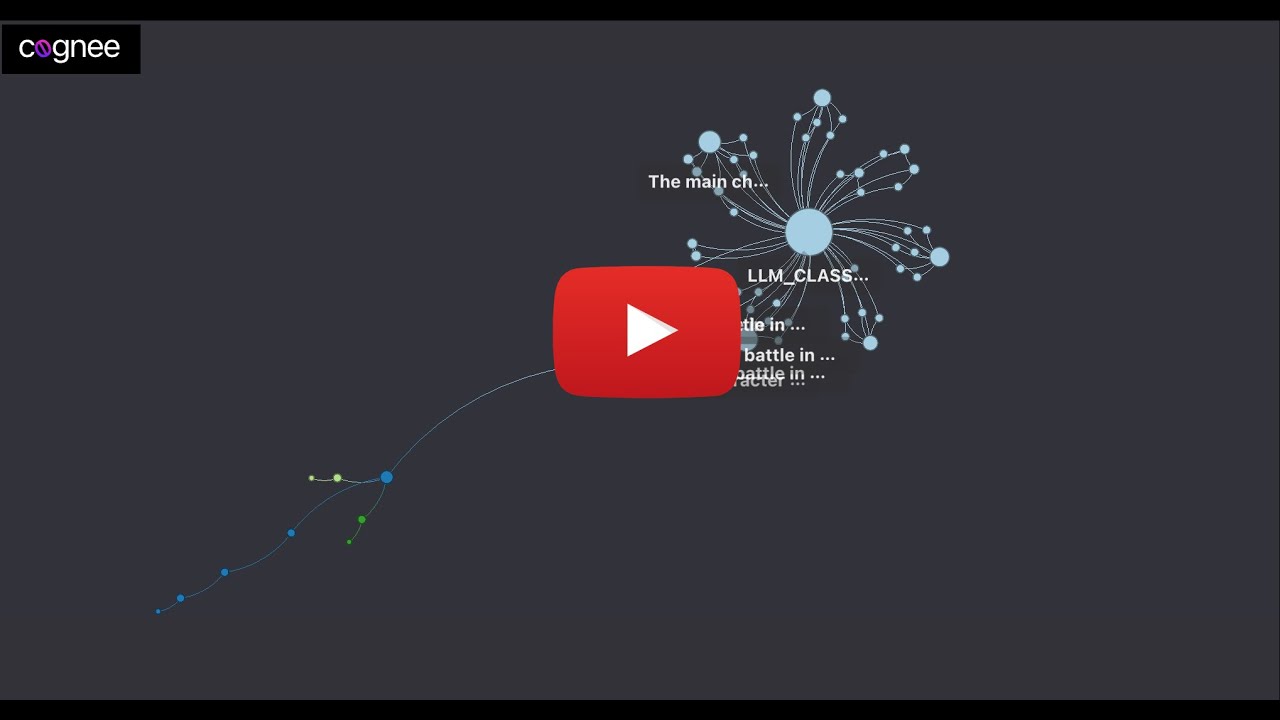
Check out our demo notebook here
Get Started
Install Server
Please see the cognee Quick Start Guide for important configuration information.
docker compose up
Install SDK
Please see the cognee Development Guide for important beta information and usage instructions.
pip install cognee