| .data | ||
| .github | ||
| assets | ||
| bin | ||
| cognitive_architecture | ||
| docs | ||
| iterations | ||
| .env.template | ||
| .gitignore | ||
| .pylintrc | ||
| __init__.py | ||
| api.py | ||
| CONTRIBUTING.md | ||
| Demo_graph.ipynb | ||
| docker-compose.yml | ||
| Dockerfile | ||
| entrypoint.sh | ||
| LICENSE | ||
| main.py | ||
| mkdocs.yml | ||
| poetry.lock | ||
| pyproject.toml | ||
| README.md | ||

cognee
AI Memory - Cognitive Architecture, Testability, Production-Ready Apps

Open-source framework for building AI Memory, extending the limits of cognitive architecture, designed for accuracy, transparency, and control.







Jump into AI memory architecture, inspired by human cognitive processes, using Python. Cognee runs in iterations, from POC towards production-ready code.
To read more about the approach and details on cognitive architecture, see the blog post: AI Applications and RAGs - Cognitive Architecture, Testability, Production Ready Apps
Try it yourself on Whatsapp with one of our partners by typing /save {content you want to save} followed by /query {knowledge you saved previously}
Getting started
Run with Docker
To run cognee you need to have Docker installed on your machine.
Run Cognee in a couple of steps:
- Run
cp .env.template .envin your terminal and set all the environment variables - Run
docker compose upin order to start graph and relational databases - Run
docker compose up cogneein order start Cognee
Debugging
To run Cognee with debugger attached you need to build the Cognee image with the DEBUG flag set to true.
docker compose build cognee --no-cache --build-arg DEBUG=truedocker compose up cognee
Run without Docker
- Run
PYTHONPATH=. python cognitive_architecture/setup_database.pyto setup database - Run
python -m gunicorn -w 1 -k uvicorn.workers.UvicornWorker -t 30000 --bind=127.0.0.1:8000 --log-level debug api:app
Debugging
- Run
python -m debugpy --wait-for-client --listen localhost:5678 -m gunicorn -w 1 -k uvicorn.workers.UvicornWorker -t 30000 --bind=127.0.0.1:8000 --log-level debug api:app - Attach debugger
Demo

Architecture
How Cognee Enhances Your Contextual Memory
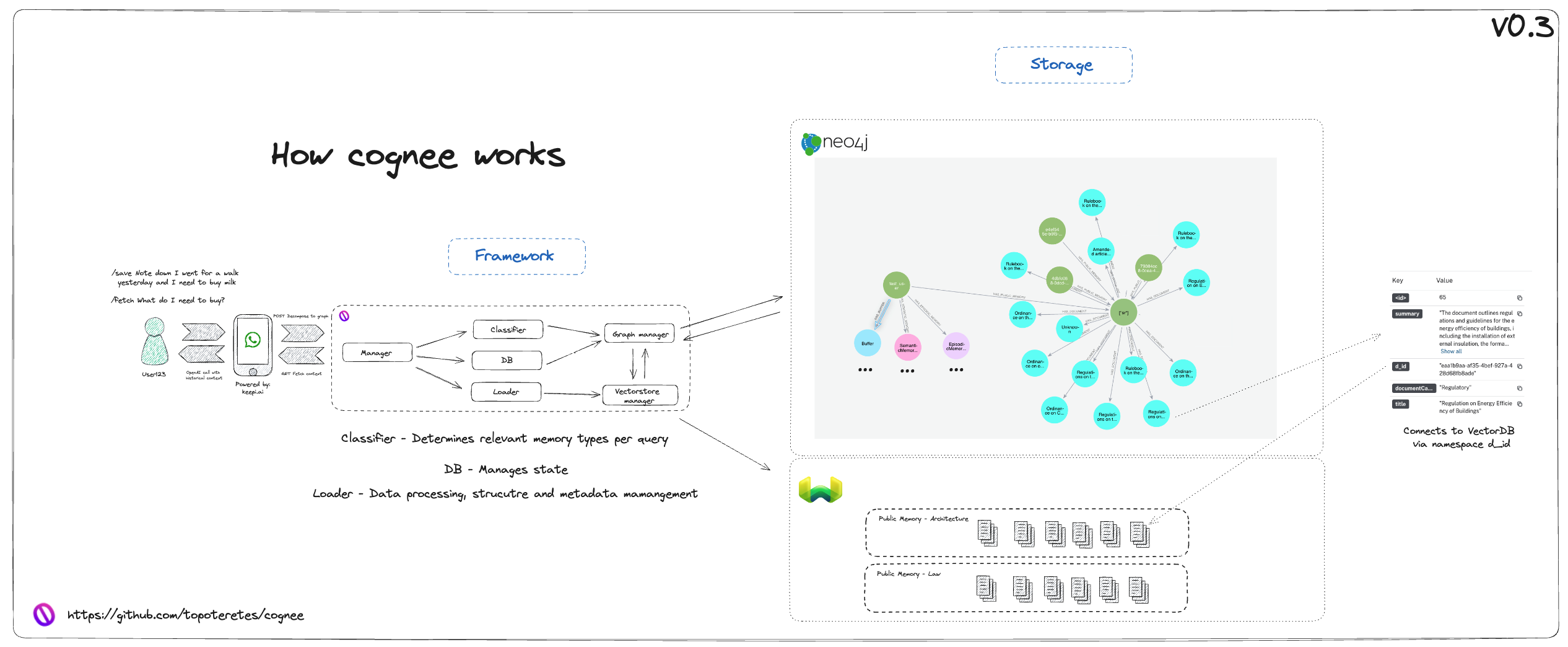
Our framework for the OpenAI, Graph (Neo4j) and Vector (Weaviate) databases introduces three key enhancements:
- Query Classifiers: Navigate information graph using Pydantic OpenAI classifiers.
- Document Topology: Structure and store documents in public and private domains.
- Personalized Context: Provide a context object to the LLM for a better response.
Current Focus
Integration with keepi.ai and other apps
- Cognee uses the Neo4j graph database to map user data into a graph structure consisting of semantic, episodic, and procedural memory.
- Stores data and files through the WhatsApp chatbot keepi.ai
- Uses the graph to answer user queries and store new information in the graph.