 3055ed89c8
<!-- .github/pull_request_template.md -->

## Description
<!--
Please provide a clear, human-generated description of the changes in
this PR.
DO NOT use AI-generated descriptions. We want to understand your thought
process and reasoning.
-->
Added tests that just run scripts we have in the docs, in our guides
section (Essentials and Customizing Cognee). This is a start of a test
suite regarding docs, to make sure new releases don't break the scripts
we have written in our docs.
The new workflow only runs on releases, and is part of the Release Test
Workflow we have.

## Type of Change
<!-- Please check the relevant option -->
- [ ] Bug fix (non-breaking change that fixes an issue)
- [x] New feature (non-breaking change that adds functionality)
- [ ] Breaking change (fix or feature that would cause existing
functionality to change)
- [ ] Documentation update
- [ ] Code refactoring
- [ ] Performance improvement
- [ ] Other (please specify):

## Screenshots/Videos (if applicable)
<!-- Add screenshots or videos to help explain your changes -->

## Pre-submission Checklist
<!-- Please check all boxes that apply before submitting your PR -->
- [ ] **I have tested my changes thoroughly before submitting this PR**
- [ ] **This PR contains minimal changes necessary to address the
issue/feature**
- [ ] My code follows the project's coding standards and style
guidelines
- [ ] I have added tests that prove my fix is effective or that my
feature works
- [ ] I have added necessary documentation (if applicable)
- [ ] All new and existing tests pass
- [ ] I have searched existing PRs to ensure this change hasn't been
submitted already
- [ ] I have linked any relevant issues in the description
- [ ] My commits have clear and descriptive messages

## DCO Affirmation
I affirm that all code in every commit of this pull request conforms to
the terms of the Topoteretes Developer Certificate of Origin.


<!-- This is an auto-generated comment: release notes by coderabbit.ai
-->

## Summary by CodeRabbit

* **Chores**
* Enhanced release workflow automation with improved coordination
between repositories.

<sub>✏️ Tip: You can customize this high-level summary in your review
settings.</sub>

<!-- end of auto-generated comment: release notes by coderabbit.ai -->
|
||
|---|---|---|
| .github | ||
| alembic | ||
| assets | ||
| bin | ||
| cognee | ||
| cognee-frontend | ||
| cognee-mcp | ||
| cognee-starter-kit | ||
| deployment | ||
| distributed | ||
| evals | ||
| examples | ||
| licenses | ||
| logs | ||
| notebooks | ||
| tools | ||
| working_dir_error_replication | ||
| .coderabbit.yaml | ||
| .dockerignore | ||
| .env.template | ||
| .gitattributes | ||
| .gitguardian.yml | ||
| .gitignore | ||
| .mergify.yml | ||
| .pre-commit-config.yaml | ||
| .pylintrc | ||
| AGENTS.md | ||
| alembic.ini | ||
| CODE_OF_CONDUCT.md | ||
| CONTRIBUTING.md | ||
| CONTRIBUTORS.md | ||
| DCO.md | ||
| docker-compose.yml | ||
| Dockerfile | ||
| entrypoint.sh | ||
| LICENSE | ||
| mypy.ini | ||
| NOTICE.md | ||
| poetry.lock | ||
| pyproject.toml | ||
| README.md | ||
| SECURITY.md | ||
| uv.lock | ||

Cognee - Accurate and Persistent AI Memory
Demo . Docs . Learn More · Join Discord · Join r/AIMemory . Community Plugins & Add-ons







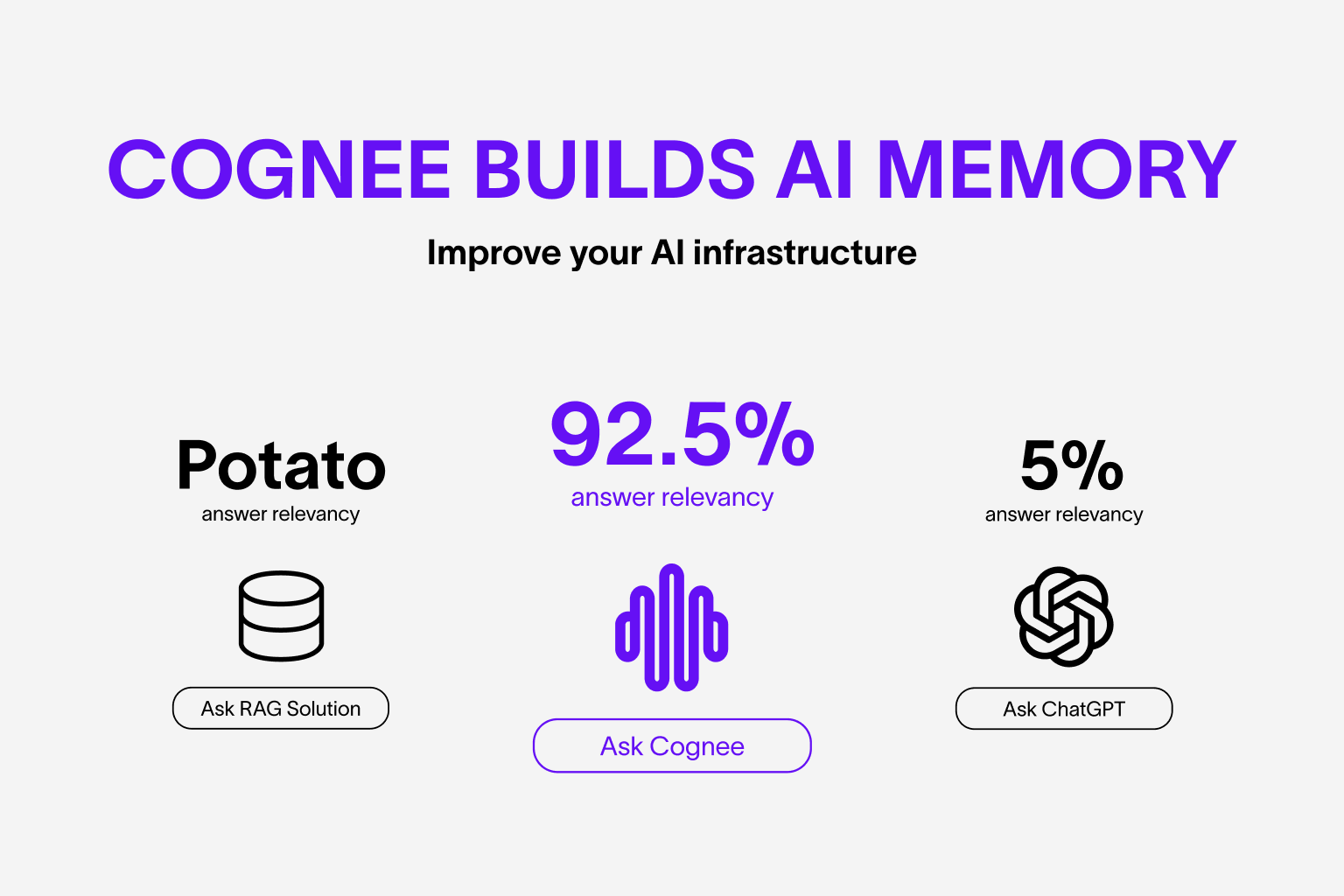
Use your data to build personalized and dynamic memory for AI Agents. Cognee lets you replace RAG with scalable and modular ECL (Extract, Cognify, Load) pipelines.
🌐 Available Languages : Deutsch | Español | Français | 日本語 | 한국어 | Português | Русский | 中文
About Cognee
Cognee is an open-source tool and platform that transforms your raw data into persistent and dynamic AI memory for Agents. It combines vector search with graph databases to make your documents both searchable by meaning and connected by relationships.
You can use Cognee in two ways:
- Self-host Cognee Open Source, which stores all data locally by default.
- Connect to Cognee Cloud, and get the same OSS stack on managed infrastructure for easier development and productionization.
Cognee Open Source (self-hosted):
- Interconnects any type of data — including past conversations, files, images, and audio transcriptions
- Replaces traditional RAG systems with a unified memory layer built on graphs and vectors
- Reduces developer effort and infrastructure cost while improving quality and precision
- Provides Pythonic data pipelines for ingestion from 30+ data sources
- Offers high customizability through user-defined tasks, modular pipelines, and built-in search endpoints
Cognee Cloud (managed):
- Hosted web UI dashboard
- Automatic version updates
- Resource usage analytics
- GDPR compliant, enterprise-grade security
Basic Usage & Feature Guide
To learn more, check out this short, end-to-end Colab walkthrough of Cognee's core features.

Quickstart
Let’s try Cognee in just a few lines of code. For detailed setup and configuration, see the Cognee Docs.
Prerequisites
- Python 3.10 to 3.13
Step 1: Install Cognee
You can install Cognee with pip, poetry, uv, or your preferred Python package manager.
uv pip install cognee
Step 2: Configure the LLM
import os
os.environ["LLM_API_KEY"] = "YOUR OPENAI_API_KEY"
Alternatively, create a .env file using our template.
To integrate other LLM providers, see our LLM Provider Documentation.
Step 3: Run the Pipeline
Cognee will take your documents, generate a knowledge graph from them and then query the graph based on combined relationships.
Now, run a minimal pipeline:
import cognee
import asyncio


async def main():
    # Add text to cognee
    await cognee.add("Cognee turns documents into AI memory.")

    # Generate the knowledge graph
    await cognee.cognify()

    # Add memory algorithms to the graph
    await cognee.memify()

    # Query the knowledge graph
    results = await cognee.search("What does Cognee do?")

    # Display the results
    for result in results:
        print(result)


if __name__ == '__main__':
    asyncio.run(main())
As you can see, the output is generated from the document we previously stored in Cognee:
Cognee turns documents into AI memory.
Use the Cognee CLI
As an alternative, you can get started with these essential commands:
cognee-cli add "Cognee turns documents into AI memory."

cognee-cli cognify

cognee-cli search "What does Cognee do?"
cognee-cli delete --all
To open the local UI, run:
cognee-cli -ui
Demos & Examples
See Cognee in action:
Persistent Agent Memory
Cognee Memory for LangGraph Agents
Simple GraphRAG
Cognee with Ollama
Community & Support
Contributing
We welcome contributions from the community! Your input helps make Cognee better for everyone. See CONTRIBUTING.md to get started.
Code of Conduct
We're committed to fostering an inclusive and respectful community. Read our Code of Conduct for guidelines.
Research & Citation
We recently published a research paper on optimizing knowledge graphs for LLM reasoning:
@misc{markovic2025optimizinginterfaceknowledgegraphs,
      title={Optimizing the Interface Between Knowledge Graphs and LLMs for Complex Reasoning},
      author={Vasilije Markovic and Lazar Obradovic and Laszlo Hajdu and Jovan Pavlovic},
      year={2025},
      eprint={2505.24478},
      archivePrefix={arXiv},
      primaryClass={cs.AI},
      url={https://arxiv.org/abs/2505.24478},
}