Cognee Logo
cognee - memory layer for AI apps and Agents [![GitHub forks](https://img.shields.io/github/forks/topoteretes/cognee.svg?style=social&label=Fork&maxAge=2592000)](https://GitHub.com/topoteretes/cognee/network/) [![GitHub stars](https://img.shields.io/github/stars/topoteretes/cognee.svg?style=social&label=Star&maxAge=2592000)](https://GitHub.com/topoteretes/cognee/stargazers/) [![GitHub commits](https://badgen.net/github/commits/topoteretes/cognee)](https://GitHub.com/topoteretes/cognee/commit/) [![Github tag](https://badgen.net/github/tag/topoteretes/cognee)](https://github.com/topoteretes/cognee/tags/) [![Downloads](https://static.pepy.tech/badge/cognee)](https://pepy.tech/project/cognee) [![License](https://img.shields.io/github/license/topoteretes/cognee?colorA=00C586&colorB=000000)](https://github.com/topoteretes/cognee/blob/main/LICENSE) [![Contributors](https://img.shields.io/github/contributors/topoteretes/cognee?colorA=00C586&colorB=000000)](https://github.com/topoteretes/cognee/graphs/contributors) We build for developers who need a reliable, production-ready data layer for AI applications



# What is cognee? Cognee implements scalable, modular ECL (Extract, Cognify, Load) pipelines that allow you to interconnect and retrieve past conversations, documents, and audio transcriptions while reducing hallucinations, developer effort, and cost. Cognee merges graph and vector databases to uncover hidden relationships and new patterns in your data. You can automatically model, load and retrieve entities and objects representing your business domain and analyze their relationships, uncovering insights that neither vector stores nor graph stores alone can provide. Learn more about use-cases [here](https://docs.cognee.ai/use_cases). Try it in a Google Colab notebook or have a look at our documentation. If you have questions, join our Discord community. Have you seen cognee's starter repo? Check it out!
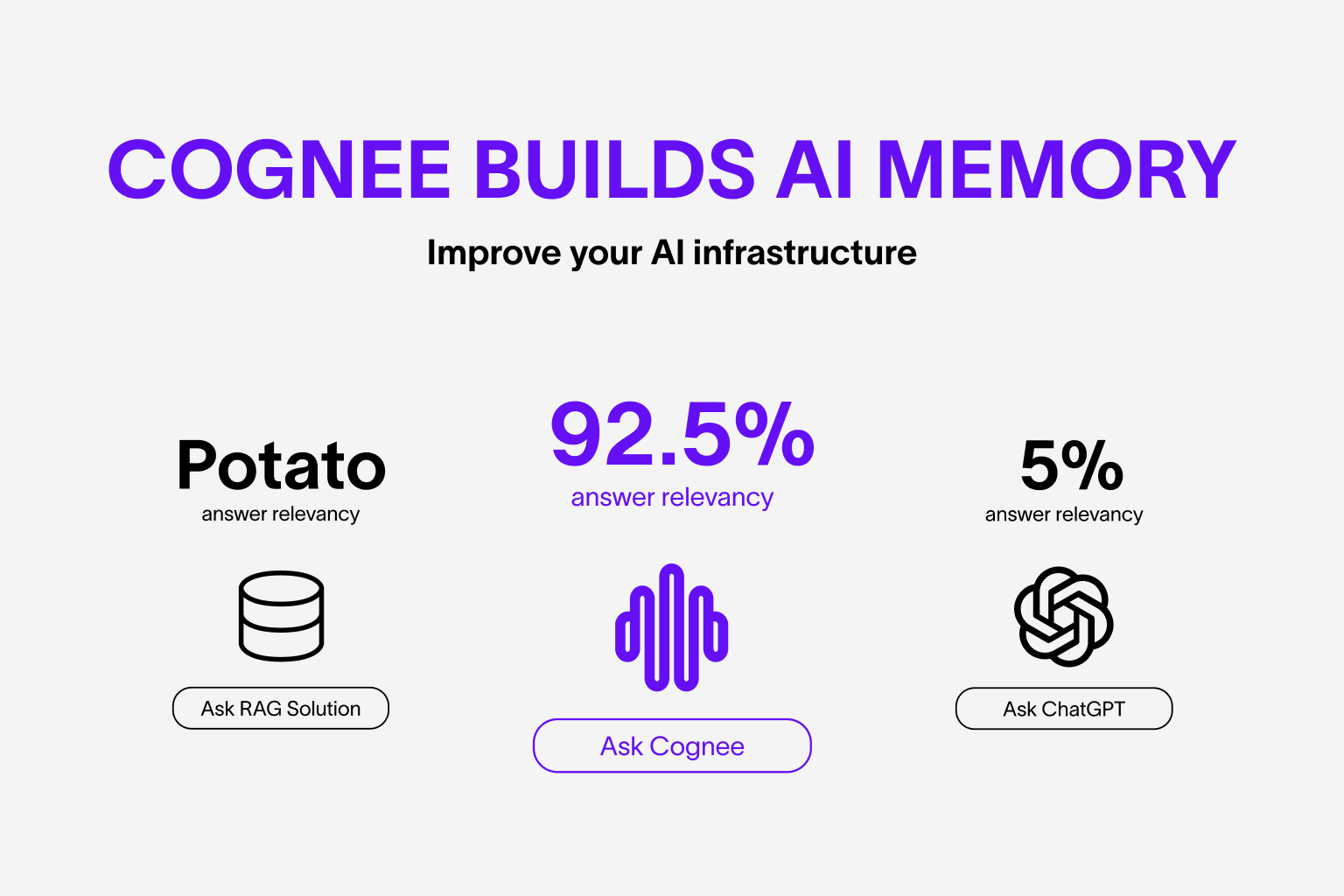
Why cognee?
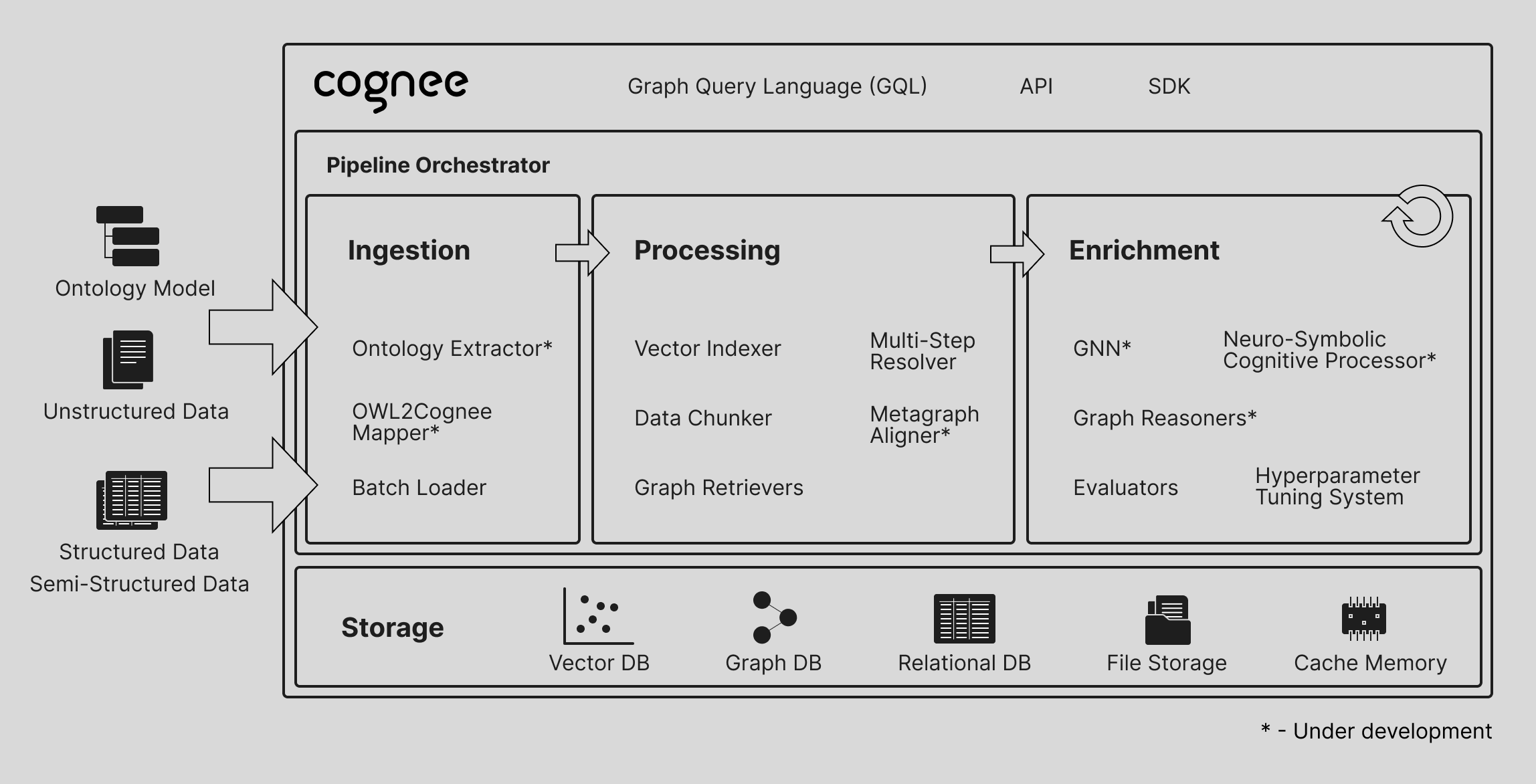
## 📦 Installation You can install Cognee using either **pip**, **poetry**, **uv** or any other python package manager. ### With pip ```bash pip install cognee ``` ### With poetry ```bash poetry add cognee ``` ### With uv ```bash uv add cognee ``` ## 💻 Basic Usage ### Setup ``` import os os.environ["LLM_API_KEY"] = "YOUR OPENAI_API_KEY" ``` or ``` import cognee cognee.config.set_llm_api_key("YOUR_OPENAI_API_KEY") ``` You can also set the variables by creating .env file, here is our template. To use different LLM providers, for more info check out our documentation ### Simple example Add LLM_API_KEY to .env using the command bellow. ``` echo "LLM_API_KEY=YOUR_OPENAI_API_KEY" > .env ``` You can see available env variables in the repository `.env.template` file. This script will run the default pipeline: ```python import cognee import asyncio from cognee.modules.search.types import SearchType async def main(): # Create a clean slate for cognee -- reset data and system state print("Resetting cognee data...") await cognee.prune.prune_data() await cognee.prune.prune_system(metadata=True) print("Data reset complete.\n") # cognee knowledge graph will be created based on this text text = """ Natural language processing (NLP) is an interdisciplinary subfield of computer science and information retrieval. """ print("Adding text to cognee:") print(text.strip()) # Add the text, and make it available for cognify await cognee.add(text) print("Text added successfully.\n") print("Running cognify to create knowledge graph...\n") print("Cognify process steps:") print("1. Classifying the document: Determining the type and category of the input text.") print("2. Checking permissions: Ensuring the user has the necessary rights to process the text.") print("3. Extracting text chunks: Breaking down the text into sentences or phrases for analysis.") print("4. Adding data points: Storing the extracted chunks for processing.") print("5. Generating knowledge graph: Extracting entities and relationships to form a knowledge graph.") print("6. Summarizing text: Creating concise summaries of the content for quick insights.\n") # Use LLMs and cognee to create knowledge graph await cognee.cognify() print("Cognify process complete.\n") query_text = "Tell me about NLP" print(f"Searching cognee for insights with query: '{query_text}'") # Query cognee for insights on the added text search_results = await cognee.search( query_text=query_text, query_type=SearchType.INSIGHTS ) print("Search results:") # Display results for result_text in search_results: print(result_text) # Example output: # ({'id': UUID('bc338a39-64d6-549a-acec-da60846dd90d'), 'updated_at': datetime.datetime(2024, 11, 21, 12, 23, 1, 211808, tzinfo=datetime.timezone.utc), 'name': 'natural language processing', 'description': 'An interdisciplinary subfield of computer science and information retrieval.'}, {'relationship_name': 'is_a_subfield_of', 'source_node_id': UUID('bc338a39-64d6-549a-acec-da60846dd90d'), 'target_node_id': UUID('6218dbab-eb6a-5759-a864-b3419755ffe0'), 'updated_at': datetime.datetime(2024, 11, 21, 12, 23, 15, 473137, tzinfo=datetime.timezone.utc)}, {'id': UUID('6218dbab-eb6a-5759-a864-b3419755ffe0'), 'updated_at': datetime.datetime(2024, 11, 21, 12, 23, 1, 211808, tzinfo=datetime.timezone.utc), 'name': 'computer science', 'description': 'The study of computation and information processing.'}) # (...) # # It represents nodes and relationships in the knowledge graph: # - The first element is the source node (e.g., 'natural language processing'). # - The second element is the relationship between nodes (e.g., 'is_a_subfield_of'). # - The third element is the target node (e.g., 'computer science'). if __name__ == '__main__': asyncio.run(main()) ``` When you run this script, you will see step-by-step messages in the console that help you trace the execution flow and understand what the script is doing at each stage. A version of this example is here: `examples/python/simple_example.py` ## Understand our architecture Cognee consists of tasks that can be grouped into pipelines. Each task can be an independent part of business logic, that can be tied to other tasks to form a pipeline. These tasks persist data into your memory store enabling you to search for relevant context of past conversations, documents, or any other data you have stored.
cognee concept diagram
## Vector retrieval, Graphs and LLMs Cognee supports a variety of tools and services for different operations: - **Modular**: Cognee is modular by nature, using tasks grouped into pipelines - **Local Setup**: By default, LanceDB runs locally with NetworkX and OpenAI. - **Vector Stores**: Cognee supports LanceDB, Qdrant, PGVector and Weaviate for vector storage. - **Language Models (LLMs)**: You can use either Anyscale or Ollama as your LLM provider. - **Graph Stores**: In addition to NetworkX, Neo4j is also supported for graph storage. - **User management**: Create individual user graphs and manage permissions ## Demo Check out our demo notebook [here](https://github.com/topoteretes/cognee/blob/main/notebooks/cognee_demo.ipynb) or watch the Youtube video below [](https://www.youtube.com/watch?v=fI4hDzguN5k "Learn about cognee: 55") ## Install Cognee with specific database support Support for various databases and vector stores is available through extras. Please see the [Cognee Quickstart Guide](https://docs.cognee.ai/quickstart/) for important configuration information. ### With pip To install Cognee with support for specific databases use the appropriate command below. Replace \ with the name of the database you need. ```bash pip install 'cognee[]' ``` Replace \ with any of the following databases: - postgres - weaviate - qdrant - neo4j - milvus Installing Cognee with PostgreSQL and Neo4j support example: ```bash pip install 'cognee[postgres, neo4j]' ``` ### With poetry To install Cognee with support for specific databases use the appropriate command below. Replace \ with the name of the database you need. ```bash poetry add cognee -E ``` Replace \ with any of the following databases: - postgres - weaviate - qdrant - neo4j - milvus Installing Cognee with PostgreSQL and Neo4j support example: ```bash poetry add cognee -E postgres -E neo4j ``` ## Working with local Cognee Install dependencies inside the cloned repository: ```bash poetry config virtualenvs.in-project true poetry self add poetry-plugin-shell poetry install poetry shell ``` ## Run Cognee API server Please see the [Cognee Quickstart Guide](https://docs.cognee.ai/quickstart/) for important configuration information. ```bash docker compose up ``` ## Contributing Your contributions are at the core of making this a true open source project. Any contributions you make are **greatly appreciated**. See [`CONTRIBUTING.md`](CONTRIBUTING.md) for more information. ## Code of Conduct We are committed to making open source an enjoyable and respectful experience for our community. See CODE_OF_CONDUCT for more information. ## 💫 Contributors contributors ## Star History [![Star History Chart](https://api.star-history.com/svg?repos=topoteretes/cognee&type=Date)](https://star-history.com/#topoteretes/cognee&Date) ## Vector & Graph Databases Implementation State | Name | Type | Current state (Mac/Linux) | Known Issues | Current state (Windows) | Known Issues | |----------|--------------------|---------------------------|--------------|-------------------------|--------------| | Qdrant | Vector | Stable ✅ | | Unstable ❌ | | | Weaviate | Vector | Stable ✅ | | Unstable ❌ | | | LanceDB | Vector | Stable ✅ | | Stable ✅ | | | Neo4j | Graph | Stable ✅ | | Stable ✅ | | | NetworkX | Graph | Stable ✅ | | Stable ✅ | | | FalkorDB | Vector/Graph | Stable ✅ | | Unstable ❌ | | | PGVector | Vector | Stable ✅ | | Unstable ❌ | | | Milvus | Vector | Stable ✅ | | Unstable ❌ | |